Who we are
AboutJamiatul Firdous
The best among you are those who learn the Qur'an and teach it.
Our mission
Every childdeserves both.
Jamiatul Firdous was founded with a simple, profound purpose: to make authentic Islamic knowledge accessible to every woman, and bring the light of the Qur'an into every home.
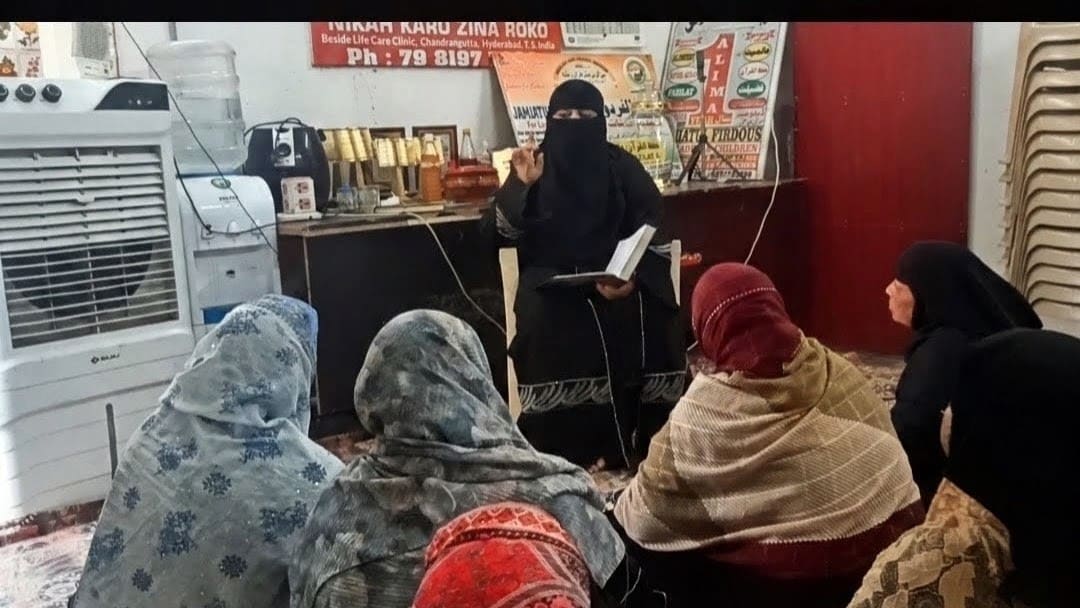
It began when Aqila Firdous, the founder of Jamiatul Firdous, took on her very first student — a woman in her forties who had never learned to recite the Qur'an with correct tajweed. Aqila Firdous taught her personally, certain that it is never too late to learn the words of Allah.
That one lesson became a mission. Countless women across India carried the same quiet wish — to read the Qur'an, refine their recitation, and deepen their Islamic knowledge — but needed a place that welcomed them at any age. So Jamiatul Firdous was born to be that place, and there has been no age limit to learning here since.
Founded in 2000 under Al Firdous Educational & Welfare Society, the school has grown from a single maktab room into several branches — and the intent behind it hasn't moved since.
What guides us
Four things wedon't compromise on
Qur'an first
Hifz and tajweed sit at the center of the day, taught by teachers who hold their own ijazah — not an elective bolted onto an academic timetable.
Sound belief
Aqeedah and fiqh are taught from the classical texts, in language a child can actually carry with them, not just recite.
A real education
Character and adab are taught with the same seriousness as tajweed, so a graduate carries themselves as well as they recite.
One community
Run under Al Firdous Educational & Welfare Society (AFEWS), the school stays answerable to the community that built it.
From the founder
A word fromAqila Firdous
Director & Principal, AFEWS
"PLACEHOLDER — a short, real quote from the founder belongs here: why the school was started, and what she hopes a graduate carries with them for life."
Our journey
Milestones sincefounding
2000
Jamiatul Firdous opens its doors under AFEWS, starting with a handful of students and a single maktab room.
PLACEHOLDER
Add the next real milestone — a new branch, the first Hifz batch to complete, a building expansion.
PLACEHOLDER
Add another milestone here, or remove this row if the timeline should stay shorter.
Today
PLACEHOLDER — a line on current scale: number of students, branches, and graduates to date.
Good to know
Questionspeople ask us
Is there an age limit for learning here?
No. Aqila Firdous's very first student was a woman in her forties who had never learned to recite the Qur'an with correct tajweed — and the school has stayed built around that since: it's never too late to enroll and learn.
Can women learn Islamic knowledge at Jamiatul Firdous?
Yes — it's the reason the school exists. Jamiatul Firdous was founded specifically to make authentic Islamic knowledge accessible to women, starting from that first student and continuing with women across India since.
Can I start from scratch, with no Qur'an reading or Islamic background at all?
Yes. The Aalimiyat track starts from qaida and builds up to full Qur'an reading with tajweed, alongside foundational aqeedah, fiqh, and duas — so someone starting with nothing is placed at that beginning point, not expected to already know it.
Can a busy mother or working woman fit this around her schedule?
Yes — Aalimiyat runs flexible morning, evening, and weekend batches, built specifically not to conflict with another timetable, whether that's a job, a household, or a day school.
Does the Jamia only teach Qur'an recitation, or also help you understand Islam?
Both. Alongside Hifz and tajweed, Aalimiyat and Fazilat cover aqeedah, fiqh, duas, and Islamic manners — and Fazilat goes further into tafsir and hadith — so recitation sits alongside actually understanding what's being recited.
What does the teaching methodology actually look like day to day?
In Hifz, each day is a new lesson (sabaq), yesterday's review (sabqi), and long-term revision (manzil), so memorized portions stay fresh instead of fading after they're set. Fazilat follows on with a classical Dars-e-Nizami–style sequence through tafsir, hadith, fiqh, and Arabic.
Come and see
See it for yourself —visit the campus
Walk the corridors during a working day. It tells you more than any page can.